1. Purpose of the Model
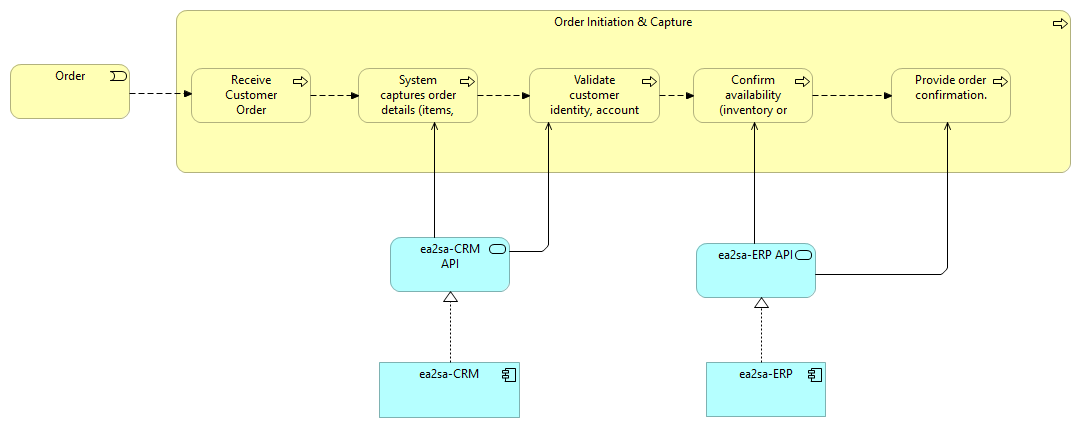
This model provides a structured enterprise architecture view of how the organization receives, validates, and confirms customer orders. It maps business process steps to the underlying CRM and ERP application services that enable them.
________________________________________
2. High-Level Description
The Order Initiation & Capture model illustrates the first major stage of the Order-to-Cash (O2C) value stream, showing how:
• Customer intent is converted into a structured and validated order.
• CRM and ERP systems collaborate to collect order details, validate customer identity, and confirm product availability.
• System interactions ensure accuracy, compliance, and readiness for downstream fulfillment and pricing processes.
________________________________________
3. Major Business Steps and Supporting Systems
3.1 Receive Customer Order
• Triggered when a customer submits an order request through any channel (web, mobile, chatbot, CSR, etc.).
• Establishes the initial event of the order lifecycle.
3.2 Capture Order Details
• The system records:
o Order items
o Quantities
o Configuration details
o Customer identifiers
• Supported by:
o ea2sa-CRM API
o ea2sa-CRM
• Ensures structured and accurate initial order data.
3.3 Validate Customer Identity & Account
• Verifies:
o Customer identity
o Account status
o Eligibility and credit category (if managed in CRM)
• Supported by:
o ea2sa-CRM API
o CRM customer master data
3.4 Confirm Availability (Inventory or Service Capacity)
• Confirms whether the requested products/services can be fulfilled.
• Includes:
o Inventory checks
o Stock reservation logic
o Availability alternatives (if needed)
• Supported by:
o ea2sa-ERP API
o ea2sa-ERP
3.5 Provide Order Confirmation
• Finalizes the initiation stage by delivering:
o Confirmation of order acceptance
o Any availability adjustments or validation notes
• Prepares the order for downstream steps such as:
o Pricing validation
o Fulfillment
o Billing
________________________________________
4. What the Model Provides
4.1 Unified Business-to-System View
• Demonstrates how early-stage O2C business processes connect to CRM and ERP application services.
4.2 Clarity in System Responsibilities
• Indicates which system:
o Owns customer identity
o Handles product and inventory validation
o Records initial order data
4.3 A Basis for Automation and Orchestration
• Enables:
o Workflow design
o API contract definition
o Microservice alignment
o Automated order validation logic
4.4 Operational and Customer Experience Benefits
• Improved order accuracy
• Faster validation and confirmation
• Reduced downstream errors
• More integrated end-to-end customer experience
________________________________________
5. Summary Statement
This model provides a complete enterprise architecture representation of how customer orders are initiated, validated, and confirmed. It links business process steps to CRM and ERP application services, forming the foundational entry point of the Order-to-Cash value stream and enabling accuracy, automation, and smooth operational handoff to fulfillment and billing.