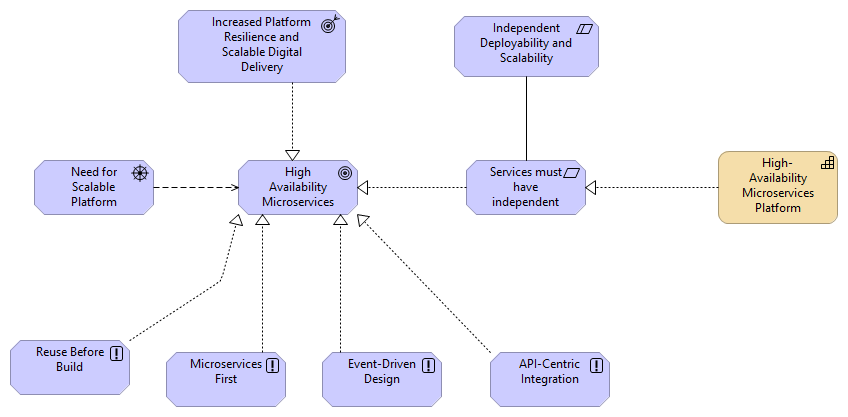
This diagram shows why we are moving toward a High-Availability Microservices Platform and how the decision is supported by our business needs, architectural goals, and guiding principles.
It organizes several key ideas:
1. Business Needs (Why Change is Necessary)
The items at the top and left represent the pressures driving our transformation—such as the need for greater scalability, resilience, and the ability to deploy services independently. These express the problems and opportunities that must be addressed.
2. Architectural Goals (What We Must Achieve)
At the center is “High Availability Microservices.” This represents the desired architectural outcome. It reflects our intention to build a platform where services can scale, fail independently, and support continuous delivery.
3. Architecture Principles (How We Will Achieve It)
The items at the bottom—such as Microservices First, Event-Driven Design, API-Centric Integration, and Reuse Before Build—represent the principles we will follow. These principles guide design decisions and ensure consistency across the platform.
4. Requirements (What Must Be True for Success)
Some items describe concrete conditions that must be satisfied, such as services needing independent deployability. These are the non-negotiable requirements that shape how the platform will be implemented.
5. Target Outcome
On the far right is the “High-Availability Microservices Platform.” This is the end state that emerges when drivers, goals, principles, and requirements align.
This model is a Business Architecture Principles-to-Capabilities View showing:
1. Business Drivers (why the organization must evolve its platform)
– Resilience
– Scalability
– Digital delivery
– Agility
2. Business Principles and Constraints (how the organization intends to operate)
– Reuse Before Build
– Microservices First
– Event-Driven Design
– API-Centric Integration
– Independence of services
3. Business Requirements (what the organization needs from its technology capabilities)
– Independent deployability
– Independent scalability
– High availability
4. Target Business-Supporting Capability
– A highly available, modular microservices platform that supports mission-critical value streams.
In short:
The model shows the business rationale and architectural principles that justify adopting a High-Availability Microservices Platform and outlines how business outcomes flow from foundational design choices.
It answers four business architecture questions:
1. Why are we moving to microservices?
To achieve resilience, scalability, speed, and digital delivery at scale.
2. What principles guide solution development?
Reuse, microservices first, event-driven interactions, API-centricity.
3. What requirements must the platform meet?
Independence, deployability, scalability, and high availability.
4. What capability are we building?
A business-aligned high-availability microservices platform that supports enterprise agility.
| Version | 1.0 |
| Status | Draft |
| Stakeholders |