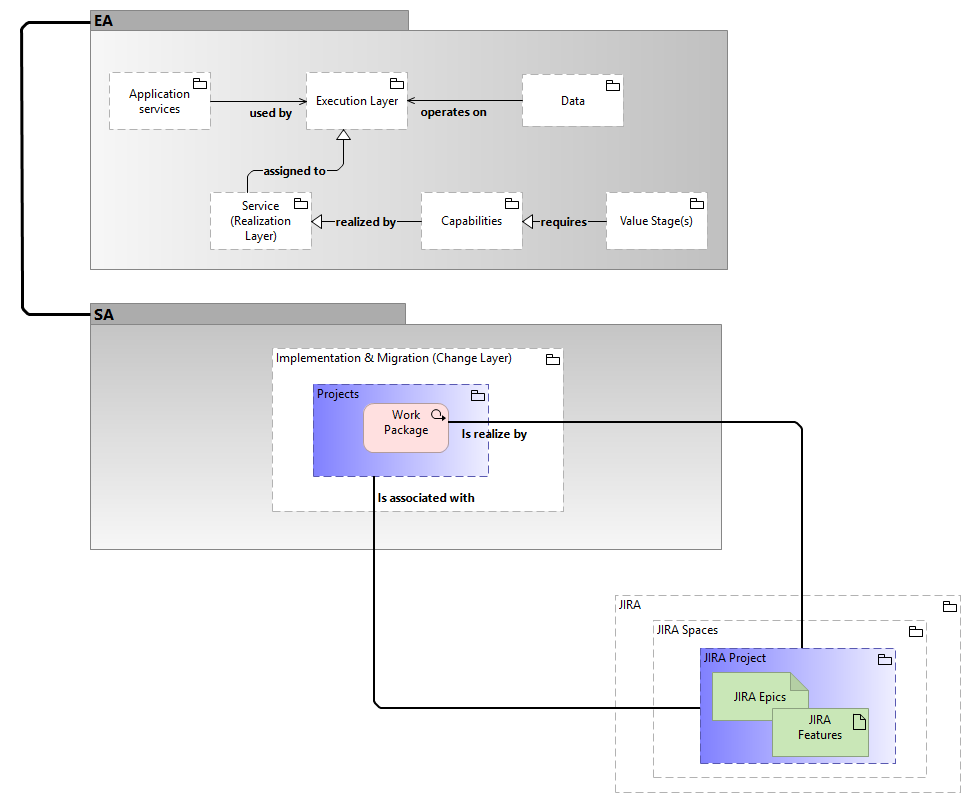
This model represents the Ea2Sa translation bridge between Enterprise Architecture (EA) and Solution Architecture (SA), showing how enterprise intent and capability design are systematically realized through delivery execution mechanisms such as projects and agile tooling (e.g., JIRA).
The model makes explicit the hand-off points, traceability paths, and responsibility boundaries between EA and SA—a core principle of the Ea2Sa approach.
________________________________________
1. Enterprise Architecture (EA) Context
The EA section (top) captures the stable architectural truth of the enterprise—elements that change slowly and provide long-term coherence.
Execution & Service Realization
• Application Services are used by the Execution Layer, representing how solution behavior consumes enterprise-defined services.
• The Execution Layer operates on Data, emphasizing that execution is inseparable from information architecture.
• Services (Realization Layer) are assigned to the Execution Layer, showing accountability for service delivery.
Capability-Driven Design
• Capabilities are realized by Services, establishing the Ea2Sa rule that capabilities are not implemented directly—they are realized through services and behavior.
• Value Stage(s) require Capabilities, grounding capabilities in measurable business value rather than technical convenience.
Ea2Sa principle illustrated:
Enterprise Architecture defines “what must be true” and “what must exist,” not “how it is built.”
________________________________________
2. Solution Architecture (SA) Context
The SA section (middle) represents change realization, where architectural intent becomes executable work.
Implementation & Migration (Change Layer)
• Projects act as change containers, not architectural artifacts.
• Work Packages represent the architecturally governed units of change.
• A Work Package is realized by implementation, meaning it produces concrete change outcomes (code, infrastructure, configuration, etc.).
• Work Packages are associated with EA elements, preserving traceability without polluting the EA layer with delivery detail.
Ea2Sa principle illustrated:
Solution Architecture translates enterprise intent into bounded, governable change.
________________________________________
3. Tooling Integration (JIRA as a Delivery System)
The JIRA section (right) explicitly acknowledges that delivery happens in tools, not architecture models.
JIRA Mapping
• JIRA Projects represent execution environments.
• Epics correspond to Work Packages, but are not equivalent:
o Work Packages = architectural intent
o Epics = delivery execution constructs
• The association between Work Package ↔ Epic provides bi-directional traceability:
o EA → SA → Delivery
o Delivery → Architectural justification
Ea2Sa rule enforced:
JIRA is a realization system, not a source of architectural truth.
________________________________________
4. Why This Model Matters in Ea2Sa
This model solves several chronic enterprise problems:
1. EA Drift
By anchoring delivery artifacts back to capabilities and value stages, EA intent cannot be bypassed.
2. Tool-Driven Architecture
JIRA does not define architecture; it implements architecture.
3. Strategy–Execution Disconnect
Capabilities and services remain visible and traceable through projects and epics.
4. Governance Without Bureaucracy
Architecture governs through relationships, not documents or gates.
________________________________________
5. Ea2Sa Core Insight Captured
This diagram embodies the central Ea2Sa thesis:
Enterprise Architecture defines value and capability.
Solution Architecture defines change and realization.
Delivery tools execute—but do not decide—architecture.