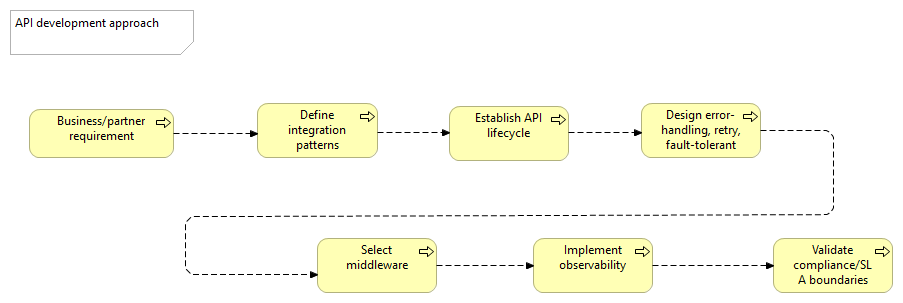
This viewpoint represents a high-level Process Flow View that outlines the stages required to design, implement, and operationalize an end-to-end API integration between a client platform and external partners. It illustrates the logical sequence of architectural decisions and validation checkpoints that ensure the resulting integration is secure, scalable, compliant, and aligned with business outcomes.
The view abstracts away technical implementation details and instead focuses on the conceptual lifecycle of API design, beginning with business requirements and concluding with operational compliance. It highlights two flow dimensions:
1. Primary Design Flow – the straight pathway from requirements through error-handling design.
2. Supporting Operational Flow – the secondary loop covering middleware selection, observability, and compliance validation.
The intention of the viewpoint is to show how API architecture decisions progress from business intent to technical execution and how they converge to produce a resilient partner-enabled capability.
________________________________________
Element Descriptions (Aligned to the Diagram)
1. Business / Partner Requirement
The entry point of the architectural process. This step captures business objectives, partner onboarding needs, required data exchanges, performance expectations, and regulatory constraints. It defines the “why” behind the integration.
2. Define Integration Patterns
A logical design step that identifies the appropriate communication models—REST, asynchronous messaging, event-driven patterns—based on business expectations and partner capabilities. This sets the foundation for the interface strategy.
3. Establish API Lifecycle
Defines how APIs will be versioned, documented, governed, secured, and evolved. This includes lifecycle stages (design, publish, maintain, retire), standards compliance (OpenAPI), and backward-compatibility planning.
4. Design Error-Handling, Retry, Fault-Tolerant Behavior
This step introduces resilience patterns such as timeouts, retries, circuit breakers, dead-letter queues, and fallback paths. It ensures that partner or network instability does not have
5. Select Middleware
A supporting flow that identifies the enabling components—API gateways, caches, service mesh capabilities, message queues, or event platforms. Middleware enforces policies, handles routing, and supports integration quality attributes like performance and reliability.
6. Implement Observability
Defines the logging, metrics, tracing, and dashboard instrumentation required to monitor API interactions and partner performance. This step ensures operational transparency and supports proactive issue detection.
7. Validate Compliance / SLA Boundaries
The final step ensures adherence to regulatory standards (PCI, GDPR, SOC2), internal security requirements, and partner-defined SLAs. It validates that the solution is ready for production from a risk, audit, and support perspective.
________________________________________
Purpose of This Viewpoint
This architectural viewpoint is designed to:
• Provide a structured and repeatable method for integrating external partners into a digital platform.
• Ensure alignment between business drivers and technical implementation.
• Highlight decision points that materially influence security, performance, resilience, and compliance.
• Serve as a communication artifact across business stakeholders, architects, integration teams, and partner engineering groups.