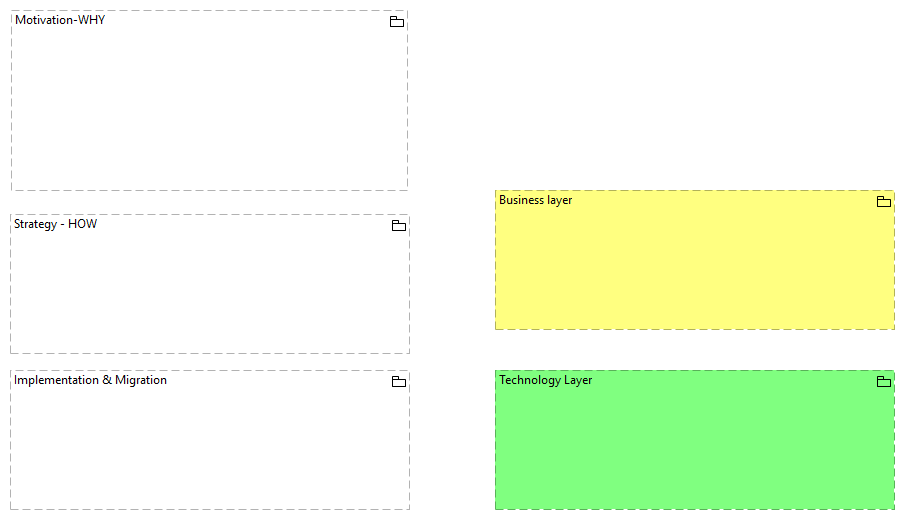
This document describes a layered enterprise architecture model developed using ArchiMate concepts and TOGAF-aligned structure. The model provides a clear, end-to-end representation of how organizational intent is translated into executable initiatives and realized through business and technology change.
The model is organized to establish traceability from motivation through strategy, business execution, implementation, and technology realization, while explicitly integrating program and project portfolio governance. Its primary purpose is to ensure architectural coherence, alignment, and accountability across the enterprise.
________________________________________
Motivation (WHY)
At the highest level, the model captures the drivers and rationale for change through the Motivation Layer. This includes organizational drivers, goals, desired outcomes, principles, requirements, and values. These elements define why the enterprise is investing in change and establish the constraints and success criteria that guide all downstream architectural decisions.
________________________________________
Strategy (HOW)
The Strategy Layer translates organizational intent into actionable direction through domain capabilities. Capabilities represent what the enterprise must be able to do to achieve its goals, independent of organizational structure or technology. This layer acts as the architectural bridge between abstract motivation and concrete business design.
________________________________________
Business Layer
The Business Layer defines how strategy is operationalized. Business services describe externally visible or internally consumed offerings, while business processes represent the structured behavior that delivers those services. Together, these elements realize enterprise capabilities and provide a stable business context for solution design.
________________________________________
Implementation & Migration
The Implementation and Migration Layer represents how architectural change is executed over time. Work packages define discrete units of change (such as projects, initiatives, or increments), and deliverables represent the tangible outputs produced. This layer enables planning, sequencing, and governance of transformation efforts while maintaining alignment with architectural intent.
________________________________________
Technology Layer
The Technology Layer captures the foundational software and hardware elements that support and enable the business and application landscape. This layer represents the physical and logical infrastructure upon which solutions are deployed and operated, ensuring that technology decisions are traceable back to business needs and strategic objectives.
________________________________________
Program & Project Portfolio Integration
The model explicitly incorporates program and project portfolio management as a governance overlay. Portfolio functions such as the PMO and IT/DevOps are shown as responsible for delivering implementation work packages and associated deliverables. This integration ensures that architectural planning, funding, prioritization, and execution remain aligned.
________________________________________
Architectural Value
This model provides:
• Clear strategy-to-execution traceability
• Strong alignment between business objectives and technology realization
• A common structure for cross-domain communication
• Explicit linkage between architecture and delivery governance
As such, it serves as a reference architecture framework suitable for enterprise planning, capability assessment, portfolio alignment, and transformation roadmap development.