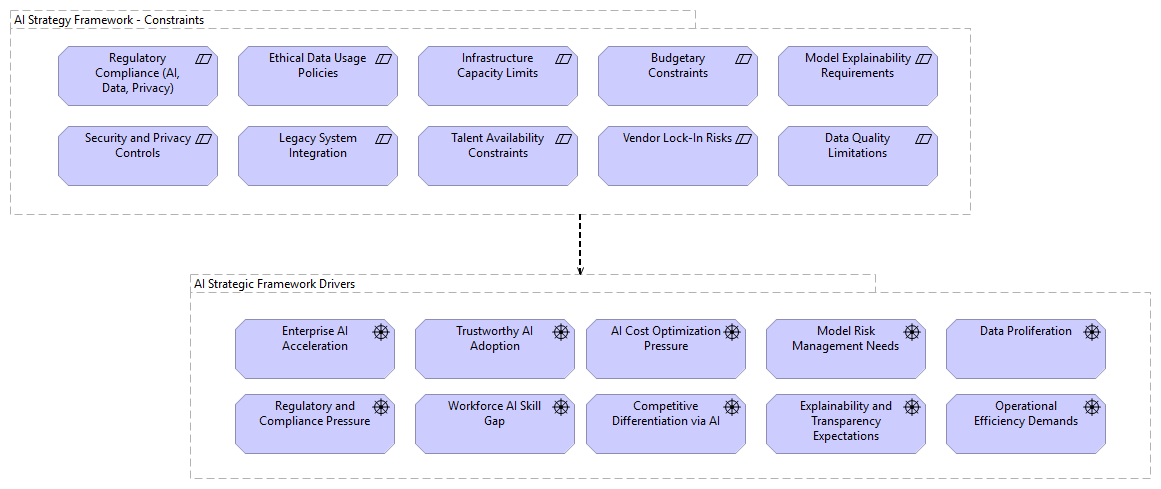
This viewpoint defines and structures the drivers and constraints influencing the formulation and evolution of the organization’s AI strategy. It provides a representation of the key motivating forces and limiting conditions that shape AI-related architectural decisions at the enterprise level.
Stakeholders
• Executive Leadership
• Enterprise Architects
• Solution Architects
• Data and AI Leadership
• Risk, Compliance, and Legal Stakeholders
• AI Governance Bodies
Stakeholder Concerns
• Alignment of AI initiatives with enterprise strategic objectives
• Compliance with regulatory, legal, and ethical requirements
• Risk exposure associated with AI adoption
• Cost, resource, and infrastructure limitations
• Transparency, explainability, and trust in AI systems
• Workforce readiness and skills availability
• Long-term sustainability and vendor dependency
The purpose of this viewpoint is to:
• Identify and communicate the primary drivers motivating AI adoption.
• Identify and communicate the primary constraints governing AI implementation.
• Provide context for downstream architectural decisions, including principles, requirements, capabilities, and solution designs.
• Support informed decision-making by making strategic trade-offs explicit.
This viewpoint applies at the enterprise strategy and motivation level and precedes capability modeling, solution architecture, and implementation design. It is concerned with enterprise-wide AI considerations rather than individual systems or technologies.
Relationships
• Drivers influence AI strategic objectives and architectural decisions.
• Constraints restrict or condition AI strategic objectives and architectural decisions.
• Drivers and constraints jointly shape the AI strategy and governance approach.
Concerns Addressed
• Why AI capabilities are required (Drivers)
• Under what conditions AI capabilities may be realized (Constraints)
Typical Stakeholder Questions
• What factors are driving the organization to invest in AI?
• What regulatory, technical, financial, or organizational limits must be considered?
• How do risk, compliance, and transparency requirements affect AI strategy?
• What trade-offs exist between AI ambition and enterprise constraints?
Rationale
Understanding both the drivers and constraints of AI adoption is essential to ensure that AI initiatives are strategically aligned, compliant, and feasible. This viewpoint provides the foundational context required to transition from strategic intent to executable architecture.